Cooperative Neurodevelopment
A framework for working with the nervous system
Lasting change comes from working with the nervous system - not against it.
Expanding capacity through partnership with the nervous system
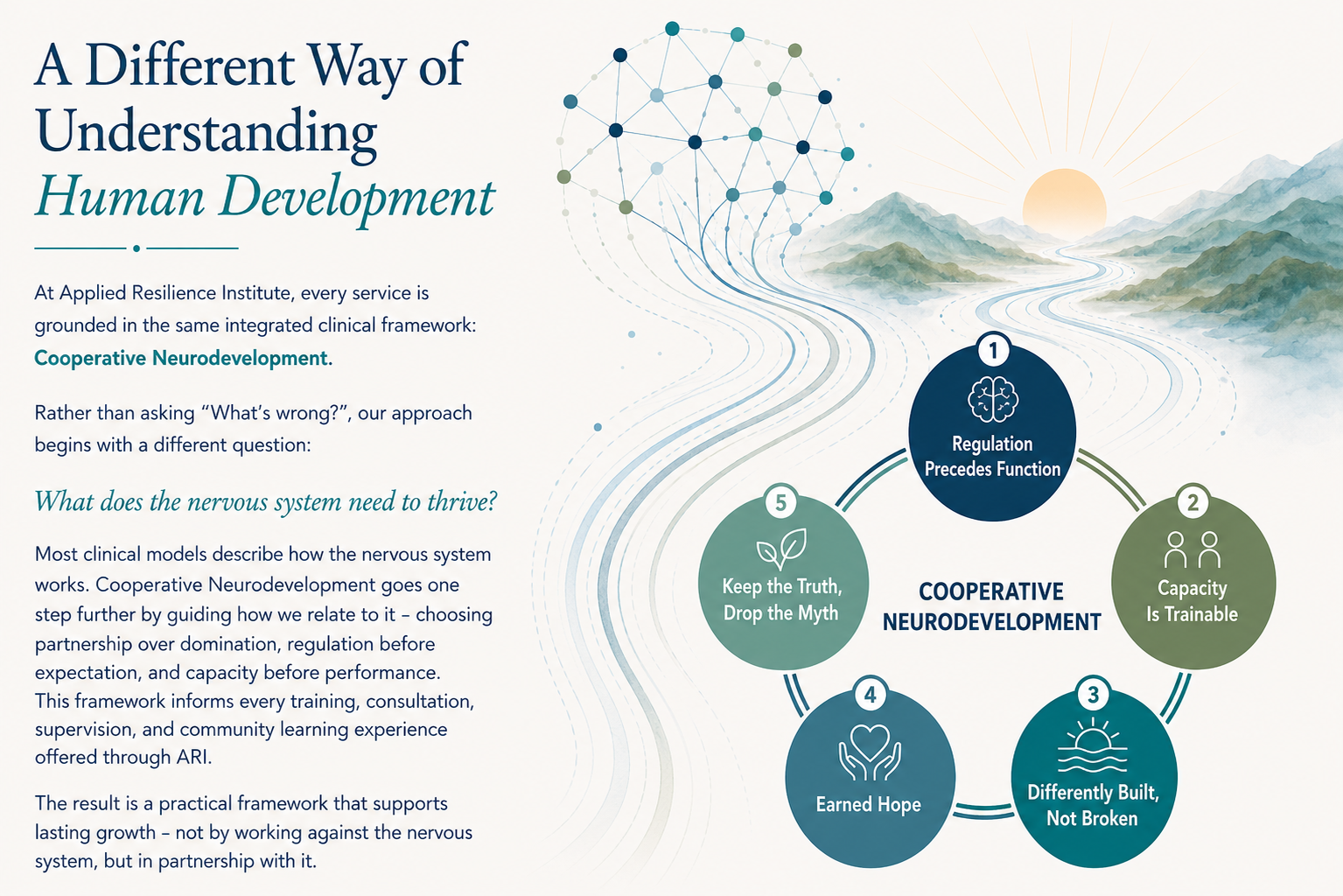
Rather than asking "What's wrong?" Cooperative Neurodevelopment asks "What does this nervous system need to thrive?"
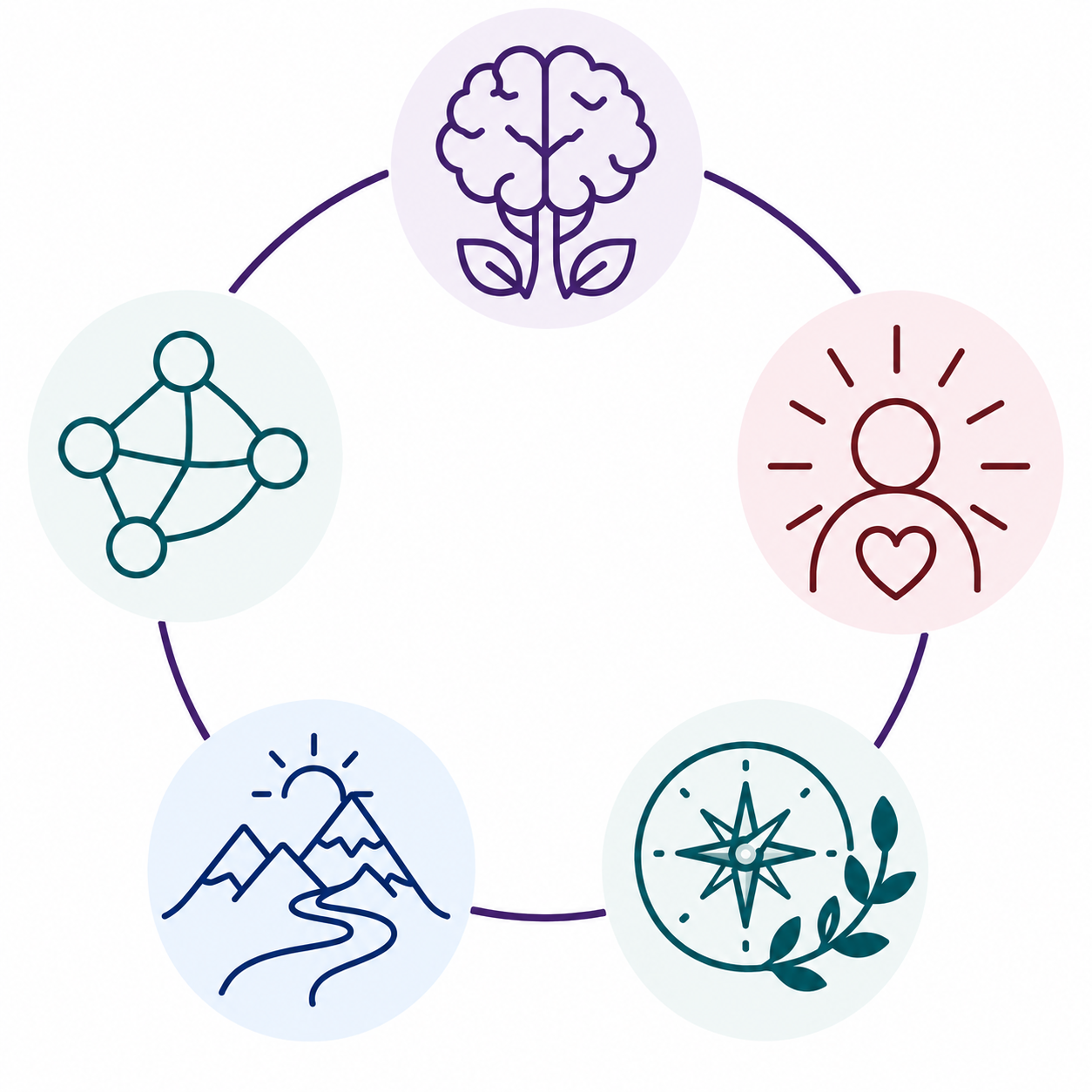
The 5 Principles:





-
Before a person can think clearly, learn, connect, make sound decisions, or process difficult experiences, their nervous system has to be regulated enough to make those capacities available. This is not a matter of motivation or intelligence — it is a matter of physiology. When the body is in a state of threat or shutdown, the parts of the brain responsible for reasoning, perspective, and flexibility are simply less accessible. This is why “just calm down” and “think it through” so often fail. You cannot think your way into a regulated state — the order runs the other way. The body settles first, and the higher functions come back online after. In practice, this means regulation is not a warm-up or a nice-to-have. It is the foundation everything else is built on: we establish enough steadiness first, and only then do the work that requires a regulated system.
-
The range a nervous system can handle — how much activation, intensity, or demand it can move through while still returning to baseline — is not a fixed trait. It can be expanded. This is one of the most hopeful realities in the science of regulation, and it is central to everything we do. But the mechanism is widely misunderstood. Capacity does not grow by force — by pushing through, flooding, or white-knuckling. It grows the way strength does: by going to the edge of what is manageable and then recovering. It is the return, not the strain, that builds the system. A completed cycle — activation that resolves — teaches the nervous system that intensity is survivable and that the edge is safe to approach again. This reframes growth entirely. We are not training people to endure more misery; we are widening the range in which they can live, work, and feel like themselves.
-
Many nervous systems — autistic, ADHD, trauma-shaped, and others — are built differently from the assumed “typical” baseline. Cooperative Neurodevelopment treats these differences as real and worthy of respect, not as defects to be corrected. The goal is never to make someone more neurotypical, or to sand down what makes them who they are. It is to reduce unnecessary suffering and expand capacity within their actual neurology — on their own terms. A system that processes the world more intensely, regulates attention differently, or reads internal signals in its own way is not a broken version of someone else. It is a different design, with its own strengths and its own real needs. This principle has practical teeth: we build support around the system in front of us, rather than asking that system to perform as though it were something it is not.
-
Hope matters — but only if it is true. Cooperative Neurodevelopment is built on earned hope: optimism grounded in honesty rather than in reassurance. Two things are true at once. Capacity is genuinely trainable, and real change is possible — that is the hope. And capacity is also bounded: neurology, chronic stress, life circumstances, and trauma history set real limits on what is available, and how quickly. Pretending those limits do not exist helps no one; it only sets people up to feel like failures when reality does not match the promise. The honesty is what makes the hope trustworthy. When we are straight about what is hard and what the real constraints are, the hope we offer can actually be believed — because it is not being sold. Earned hope holds possibility and limitation together, and refuses to flatten either one.
-
The field is full of compelling stories that are not quite accurate — and some that are actively unhelpful. Cooperative Neurodevelopment is committed to keeping what is true and letting go of the myths, even when the myths are popular or comforting. That means being honest that pushing through can shrink capacity rather than build it; that resilience is not simply a matter of individual grit; and that some widely repeated claims about the body and stress are metaphors, not mechanisms. It also means holding our own models lightly — useful maps like polyvagal theory are clinically valuable without being treated as settled, final fact. Dropping a myth does not mean losing the hope inside it. Usually there is an accurate version that is just as encouraging and far more useful. We keep that — the truth — and build on it.
-
These five are not a checklist to move through in order. They are a single, integrated stance. Regulation makes function possible. Capacity-building widens what is possible over time. Honoring how a system is built keeps the work grounded in reality. And earned hope, together with a commitment to truth, keeps the whole thing honest. Partnership, not domination - a way of meeting people with deep respect for how their nervous system actually works, real belief in their capacity to grow, and the honesty to tell them the truth along the way.
-
For individuals, it means support that starts with the body, builds capacity at a humane pace, and never asks you to become someone you are not. For clinicians, it is a stance and a method - regulation before reprocessing, adaptation over rigid protocol, and accuracy over comforting story. For organizations, it scales to the collective nervous system of a team or culture - because the same partnership-based principles that help a person also help a system. Across all of these, the through-line is constant: work with the nervous system’s nature, and people can finally think, create, connect, and sustain.